
Image Credits: frontend-text
Food, Beverage & Dining


Jay Chou 10 Hidden-Favorite Restaurants in Taipei
A data-led ranking of 10 Taipei restaurants editorially aligned with Jay Chou’s Chinese-style confidence and street-culture image, comparing cultural heritage, modern interpretation, product creativity, narrative and memory, and scarcity and public visibility.
Taïrroir wins this ranking by making Taiwanese memory feel formally ambitious without becoming culturally anonymous. Its 98.1 supplied composite score is supported by the list's highest product-creativity result and strong performance across heritage, modern styling and public visibility. The outcome captures the central tension behind this ranking: the closest culinary parallel to Jay Chou's public image does not preserve tradition unchanged. It gives familiar material a new rhythm while keeping the source recognizable.
The analysis compares 10 Taipei restaurants across five dimensions: cultural heritage, contemporary and street-led interpretation, product creativity, nostalgic narrative and collective memory, and scarcity and visibility. Scores are presented as supplied in the source ranking. The result is an editorial style-match based on public information and reviews; inclusion does not imply that Jay Chou has visited, approved or endorsed a restaurant.
Ranking Snapshot
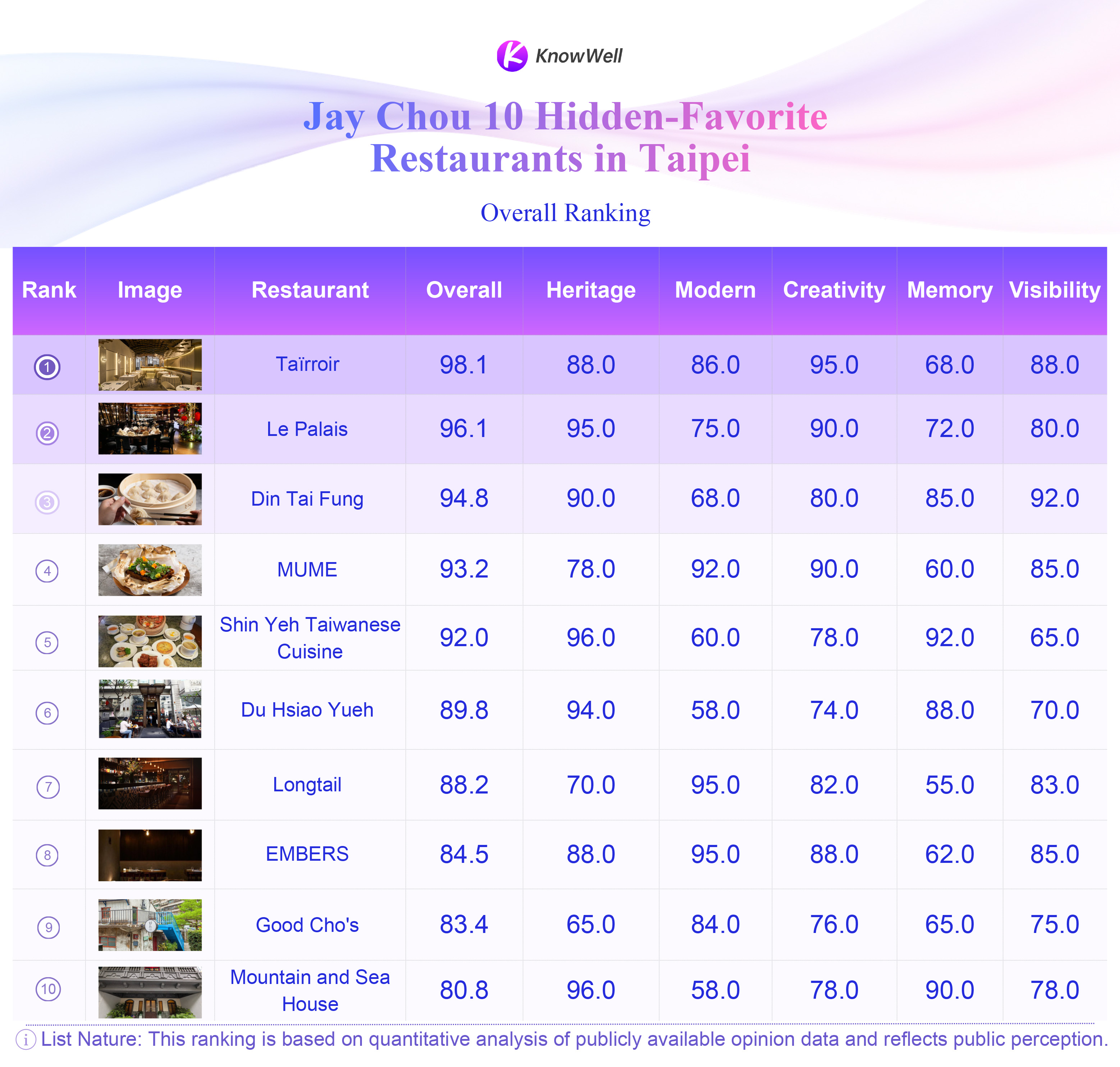
1. Taïrroir is the modern-memory leader. A 95.0 creativity score gives it the list's clearest advantage, while strong heritage and modern results show why reinterpretation works best when the reference remains visible.
2. Le Palais and Din Tai Fung define two poles of Chinese dining. One uses ceremony, luxury and palace aesthetics; the other turns precision and consistency into a globally legible Taiwanese symbol.
3. Shin Yeh, Du Hsiao Yueh and Mountain and Sea House make nostalgia active. Family dining, Tainan snack culture and revived banquet techniques convert collective memory into repeatable restaurant experiences.
4. Longtail and EMBERS supply the street-culture counterpoint. Their 95.0 modern scores lead the ranking, but lower memory scores show that visual currency and emotional inheritance do not always move together.
Top 10 Restaurant Highlights
1. Taïrroir (98.1 points)
Key themes: Taiwanese memory, French technique and creative reconstruction
Chef Kai Ho builds dishes from recognizable Taiwanese references and reorganizes them through fine-dining technique. Familiar forms such as preserved radish omelette become vehicles for texture, pacing and visual precision rather than nostalgic replicas. A ranking-leading 95.0 creativity score makes Taïrroir the clearest culinary parallel to Jay Chou's ability to place culturally familiar material inside a modern international format.
Where opinions divide: Its 68.0 memory score suggests that conceptual transformation can create distance from the communal, everyday feeling of the original dishes.
2. Le Palais (96.1 points)
Key themes: Cantonese technique, ceremonial dining and palace aesthetics
Le Palais presents Chinese dining through intricate technique, formal service and a richly decorated room shaped by screens, dark wood and ceremonial detail. Its 95.0 heritage score is among the highest in the ranking, while a 90.0 creativity score shows that tradition here is executed with technical ambition rather than treated as atmosphere alone.
Where opinions divide: The luxury-hotel setting can make cultural confidence feel exclusive, with less connection to Taipei's everyday street and neighborhood life.
3. Din Tai Fung (94.8 points)
Key themes: Xiaolongbao, precision and global Taiwanese recognition
Din Tai Fung transformed a focused Taiwanese dumpling craft into one of the island's most recognizable global restaurant identities. Transparent kitchens, standardized folds and disciplined service turn consistency into spectacle. Strong heritage, memory and visibility scores explain why the brand operates simultaneously as comfort food, civic pride and an international gateway to Taiwanese dining.
Where opinions divide: Scale and standardization support global trust, but they leave less room for the surprise or individual authorship found in smaller restaurants.
4. MUME (93.2 points)
Key themes: Nordic influence, Taiwanese produce and industrial polish
MUME combines techniques associated with New Nordic cooking and ingredients sourced from Taiwan within a restrained, industrial room. Its 92.0 modern score and 90.0 creativity score make it one of the ranking's strongest examples of culinary crossover. The restaurant's value lies in treating local produce as the center of an international conversation rather than as a decorative regional note.
Where opinions divide: A 60.0 memory score reflects the concept's forward momentum; it is more closely tied to the contemporary dining scene than to shared nostalgia.
5. Shin Yeh Taiwanese Cuisine (92.0 points)
Key themes: Banquet dishes, family gatherings and old Taipei memory
Founded in the late 1970s, Shin Yeh has become a durable reference for Taiwanese banquet and home-style flavors. Its strongest assets are continuity and social use: dishes live not only through recipes, but through family celebrations and repeated gatherings. A 96.0 heritage score and 92.0 memory score give it the ranking's deepest combination of tradition and collective recognition.
Where opinions divide: Lower modern and visibility scores show the trade-off of continuity: the restaurant protects a familiar vocabulary rather than competing through trend-led reinvention.
6. Du Hsiao Yueh (89.8 points)
Key themes: Tainan noodles, multigenerational flavor and portable heritage
Du Hsiao Yueh carries the story of Tainan danzai noodles into Taipei through a compact dish built from broth, minced pork and inherited preparation. Its 94.0 heritage score and 88.0 memory score make it one of the list's strongest vehicles for regional food memory. The restaurant demonstrates how a small-format snack can hold a much larger cultural narrative.
Where opinions divide: A 58.0 modern score and relatively modest creativity result reflect preservation rather than transformation as the concept's main purpose.
7. Longtail (88.2 points)
Key themes: Asian small plates, cocktails and nightlife energy
Longtail combines Asian-inflected small plates, creative cocktails, industrial materials and neon detail in a format designed for Taipei's younger social scene. Its 95.0 modern score is joint highest in the ranking. The restaurant aligns with the streetwear and nightlife side of Jay Chou's public image through atmosphere, rhythm and social flexibility.
Where opinions divide: The ranking's lowest memory score at 55.0 shows that immediate cultural energy is not the same as long-term emotional inheritance.
8. EMBERS (84.5 points)
Key themes: Indigenous ingredients, local sourcing and contemporary design
EMBERS connects Taiwanese ingredients and Indigenous food knowledge to a contemporary restaurant language. Local produce and techniques are framed within a cedar-rich interior whose organic geometry evokes shelter and gathering. Joint-leading modernity at 95.0, together with strong heritage and creativity scores, makes it the ranking's most balanced experimental concept.
Where opinions divide: A 62.0 memory score indicates that the restaurant's cultural work is exploratory and educational rather than broadly rooted in mass nostalgia.
9. Good Cho's (83.4 points)
Key themes: Military dependents village, bagels and creative-park leisure
Located within the Four Four South Village cultural area, Good Cho's places bagels and casual brunch inside preserved red-brick architecture associated with Taipei's military dependents village history. The concept works through juxtaposition: local urban memory becomes the setting for a relaxed, youth-oriented gathering place. An 84.0 modern score captures that accessible cultural remix.
Where opinions divide: Lower heritage and memory scores reflect a venue that uses history as context more than as the central logic of its food.
10. Mountain and Sea House (80.8 points)
Key themes: Banquet revival, archival technique and historic elegance
Mountain and Sea House focuses on reviving Taiwanese banquet cuisine and techniques that had become difficult to encounter, including elaborate dishes linked to earlier restaurant culture. A historic-style residence reinforces the sense of culinary recovery. Its 96.0 heritage score and 90.0 memory score place it alongside Shin Yeh as one of the ranking's strongest preservation projects.
Where opinions divide: A 58.0 modern score and the lowest supplied overall position show how deep preservation can be undervalued when a ranking also rewards trend visibility and contemporary design.
Quick Dining Guide
Preference | Recommended restaurants | Why they fit |
Modern Taiwanese tasting | Taïrroir / MUME | International technique organized around Taiwanese memory, ingredients and authorship. |
Formal Chinese dining | Le Palais / Mountain and Sea House | Ceremonial rooms and technique-led engagement with Chinese or Taiwanese banquet traditions. |
National food symbols | Din Tai Fung / Du Hsiao Yueh | Globally legible foods carrying strong Taiwanese recognition and regional memory. |
Family-style nostalgia | Shin Yeh / Mountain and Sea House | Banquet dishes and revived techniques connected to collective dining memory. |
Contemporary social scene | Longtail / Good Cho's | Casual, design-conscious venues tied to nightlife or creative-district culture. |
List Nature: frontend-text