
Image Credits: frontend-text
Food, Beverage & Dining


Lisa Bangkok Food Map:Top 10 Thai Restaurants
A data-led ranking of 10 Bangkok restaurants aligned with Lisa’s Thai pride and global image, comparing culinary heritage and local ingredients, modern interpretation, chef and cultural narratives, booking difficulty, and public visibility.
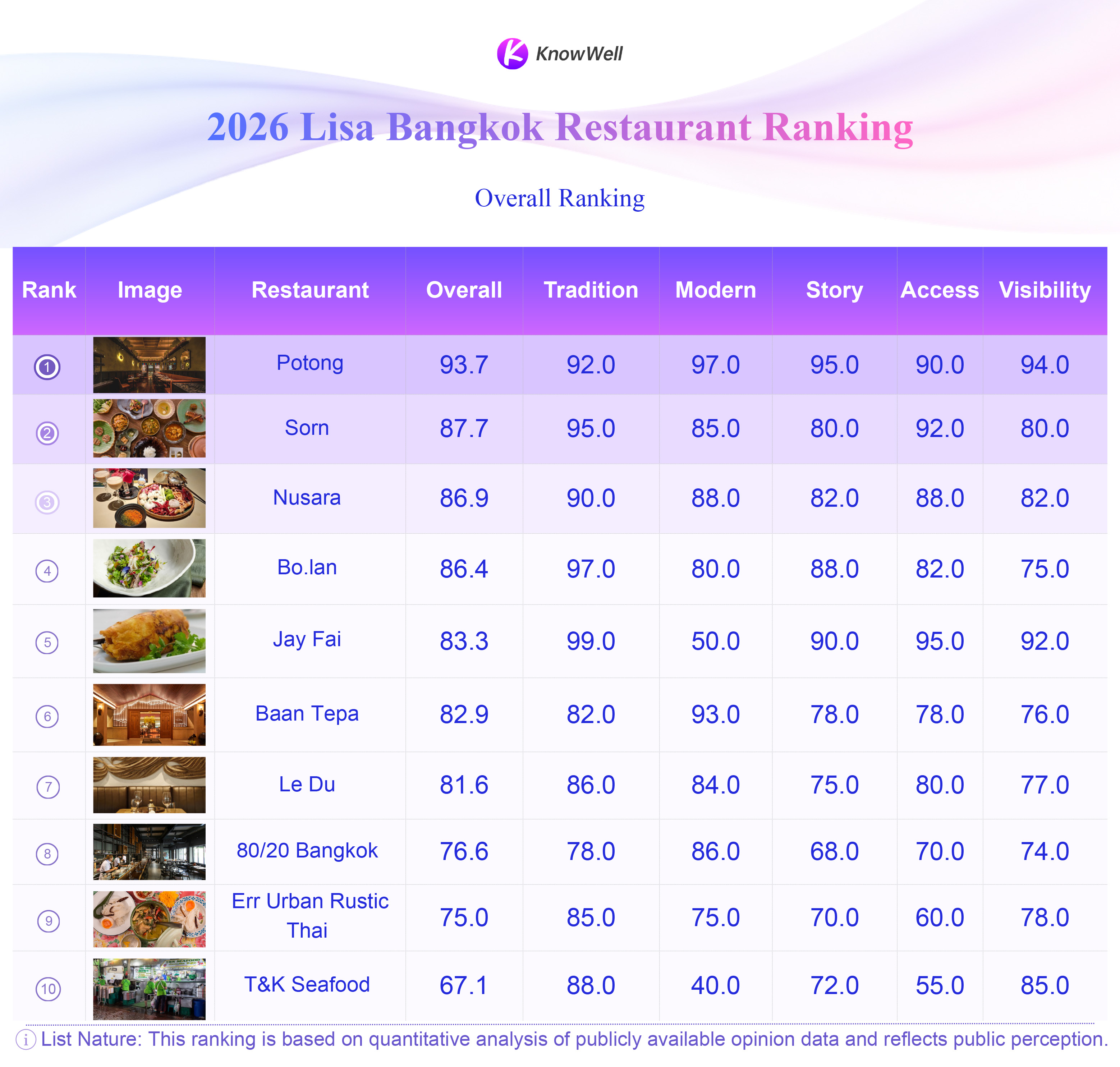
Potong wins this ranking by turning inheritance into contemporary theatre. Its 93.7 overall score is supported by category-leading modern interpretation and near-leading results for Thai-Chinese roots, cultural narrative, scarcity and visibility. The restaurant's advantage reveals the central logic behind this list: the strongest match for Lisa's public image does not choose between local pride and international polish. It makes each one more legible through the other.
The analysis compares 10 Bangkok restaurants across five weighted dimensions: traditional foundation and local ingredients, modern interpretation, chef and cultural narrative, scarcity and booking difficulty, and public visibility. The result is an editorial style-match based on public information and reviews. Inclusion does not imply that Lisa has visited, approved or endorsed a restaurant.
Ranking Snapshot
1. Potong is the decisive leader. It tops modern interpretation at 97.0 and cultural narrative at 95.0 while remaining strong across every other dimension, creating the list's most complete local-to-global proposition.
2. Sorn, Nusara and Bo.lan form the revivalist core. Each protects Thai culinary memory through a different method: regional precision, family-inflected contemporary cooking or systematic restoration of traditional recipes.
3. Jay Fai is the ranking's most productive contradiction. A 99.0 traditional score and 95.0 scarcity score overcome the list's lowest modern score, proving that originality can come from refusing reinvention.
4. Yaowarat is the list's cultural anchor. Potong and T&K Seafood sit at opposite ends of the ranking, while public reporting around Lisa's ROCKSTAR video gives the wider district the clearest direct Lisa Effect in the sample.
Top 10 Restaurant Highlights
1. Potong (93.7 points)
Key themes: Family legacy, Thai-Chinese memory and contemporary theatre
Chef Pichaya Pam Soontornyanakij transformed her family's century-old Chinese medicine building into a restaurant without erasing its wooden cabinets, worn surfaces or layered history. Against that shell, contemporary art and an open kitchen create deliberate tension. The menu reworks Teochew migration and Thai-Chinese food memory through modern technique, making biography, building and plate part of one narrative.
Where opinions divide: A highly choreographed tasting format and difficult booking process make the experience less spontaneous than Bangkok's everyday food culture.
2. Sorn (87.7 points)
Key themes: Southern Thai technique, regional detail and rare access
Sorn focuses on the food of southern Thailand, using regional ingredients, spice structures and techniques that are often simplified outside their home context. Its 95.0 traditional score and 92.0 access score reflect both culinary focus and limited availability. The restaurant's refinement works because it begins with specificity rather than treating Thai cuisine as one broad flavor category.
Where opinions divide: Exclusivity is part of the appeal but also its clearest limitation; access can shape reputation as strongly as the meal itself.
3. Nusara (86.9 points)
Key themes: Historic setting, family memory and contemporary Thai cooking
Nusara places contemporary Thai cuisine inside a restored building near the historic Charoen Krung corridor. Old beams and walls supply texture, while the menu connects fine-dining technique to domestic and street-food memories. Strong scores for both modern interpretation and scarcity make it one of the ranking's most balanced expressions of heritage made intimate.
Where opinions divide: Its polished format may feel more like a curated memory of everyday flavor than everyday dining itself.
4. Bo.lan (86.4 points)
Key themes: Recipe restoration, local sourcing and cultural depth
Bo.lan helped establish the idea that historical Thai recipes, regional knowledge and serious sourcing could support a contemporary Bangkok restaurant without becoming decorative nostalgia. Its 97.0 traditional score is the highest among the fine-dining venues, while an 88.0 narrative score reflects long-term attention to producers, sustainability and culinary preservation.
Where opinions divide: Its quieter public visibility and less theatrical modernity make it culturally influential without giving it the ranking's strongest visual momentum.
5. Jay Fai (83.3 points)
Key themes: Wok fire, crab omelette and street-food legend
Jay Fai's goggles, charcoal-fired woks and crab-filled omelette have become a global image of Bangkok street cooking. The venue earns the ranking's highest traditional score at 99.0 and an exceptional scarcity score of 95.0. Its power comes from continuity: technique, personality and setting remain inseparable, even as international attention has transformed the scale of demand.
Where opinions divide: A 50.0 modern score is not simply a weakness; it records the restaurant's deliberate refusal to convert street-food identity into fine-dining presentation.
6. Baan Tepa (82.9 points)
Key themes: Farm-to-table sourcing, modern space and Thai ingredients
Baan Tepa connects Thai producers, farmers and fishing communities to a contemporary tasting experience. Natural light and woven materials give the dining room a modern Thai visual language, while a 93.0 modern score places it just behind Potong in that category. The restaurant represents a future-facing route built from supply chains rather than nostalgia alone.
Where opinions divide: Its traditional and cultural-narrative scores are solid rather than dominant, reflecting a concept led more by contemporary systems and sourcing.
7. Le Du (81.6 points)
Key themes: Seasonality, local produce and contemporary Thai foundations
Le Du helped make contemporary Thai cuisine legible to an international fine-dining audience. Seasonal ingredients from across Thailand are organized through precise technique and presentation without abandoning recognizable flavor logic. Its balanced tradition and modern scores show why it remains a foundational reference for Bangkok's current restaurant generation.
Where opinions divide: Because its approach has become influential, what once felt radical can now appear familiar beside newer, more story-driven rooms.
8. 80/20 Bangkok (76.6 points)
Key themes: Seasonal menus, Chinatown setting and small-scale creativity
Set in an older Chinatown building, 80/20 Bangkok emphasizes local seasonal ingredients within a compact, creative format. Weekly or frequently changing ideas, refined plating and a relaxed room support an 86.0 modern score. It works as a smaller-scale alternative to the highly choreographed restaurants above it.
Where opinions divide: Lower narrative and scarcity scores mean the concept has less myth and access pressure surrounding the meal.
9. Err Urban Rustic Thai (75.0 points)
Key themes: Street snacks, communal energy and informal tradition
Created by the team associated with Bo.lan, Err reframes Thai street snacks and drinking food in a looser, more social environment. Wooden communal tables and enamelware preserve the atmosphere of casual eating rather than smoothing it into fine dining. Its 85.0 traditional score gives the restaurant a clear foundation despite its relaxed presentation.
Where opinions divide: Lower scarcity and modern scores reflect accessibility and informality - qualities that help the experience even as they reduce its ranking position.
10. T&K Seafood (67.1 points)
Key themes: Yaowarat seafood, street energy and district visibility
T&K Seafood is a visible Yaowarat street-corner landmark built around open-air seafood dining and Chinatown night-market energy. The district received renewed international attention after appearing in Lisa's 2024 ROCKSTAR video, making this entry the list's clearest link to a publicly reported Lisa Effect. Its 88.0 traditional score keeps it grounded in place.
Where opinions divide: The lowest modern and access scores in the ranking show that cultural relevance and public attention do not automatically create a high-end or scarce experience.
Three Dining Trends Behind the Ranking
Heritage Works Best When It Drives the Menu
Potong, Sorn, Nusara and Bo.lan do not use tradition as surface decoration. Family migration, regional technique, historical recipes and domestic memory determine what reaches the plate. Modern presentation matters because it clarifies those foundations rather than replacing them.
Modernity Is Not a Single Visual Language
Potong's art-filled old building, Baan Tepa's natural materials and Jay Fai's street-side woks all feel current for different reasons. The first creates contrast, the second builds a contemporary sourcing system, and the third remains modern through personality and global relevance rather than redesign.
Old Bangkok Is the Cultural Engine
Yaowarat, Talat Noi, Charoen Krung and the Old Town concentrate many of the ranking's strongest stories. Historic buildings and street-food ecosystems give chefs more than atmosphere: they supply migration, trade and neighborhood memory. The city's restaurant future is being written through its older districts.
Quick Dining Guide
Preference | Recommended restaurants | Why they fit |
Heritage and theatre | Potong / Nusara | Historic settings and personal narratives translated into contemporary tasting menus. |
Regional tradition | Sorn / Bo.lan | Deep attention to southern cuisine, historical recipes and local ingredient knowledge. |
Modern Thai foundations | Le Du / Baan Tepa | Contemporary technique led by seasonality, sourcing and a global dining language. |
Street-food energy | Jay Fai / T&K Seafood | Two highly visible expressions of Bangkok street dining, with very different demand profiles. |
Relaxed creative meal | 80/20 / Err | Smaller-scale concepts that keep the experience inventive or social without maximum ceremony. |
Future Outlook
This ranking suggests that Bangkok's contemporary restaurant identity is moving beyond the simple opposition between street food and fine dining. The most compelling venues treat them as connected systems: both depend on local ingredients, inherited technique, neighborhood memory and a strong individual point of view.
Historic districts will remain important because they give modern restaurants cultural friction. The challenge is to avoid turning old buildings and family stories into predictable branding. As more venues adopt heritage language, the food will have to carry a larger share of the argument.
For a Lisa-aligned route, Potong offers the clearest model: Thai pride is not framed as retreat from the international stage, but as the material used to command it. The restaurants most likely to endure will make local specificity feel expansive rather than fixed in the past.
List Nature: frontend-text