


Start with the Peak - a black croissant split by a seam of vivid green matcha, plated like sculpture rather than pastry - and you begin to understand why Nudake sits alone at the top of this list. Its 90.9 score is 7.9 points clear of second place, and that gap is no accident. Nudake does not really behave like a cafe; it behaves like a fashion house that happens to serve dessert. That is precisely the split this ranking rewards - couture-level control colliding with street-level impact - and no other address in Seoul resolves it so completely.
The analysis compares 10 Seoul cafes across five weighted dimensions: spatial mix, product creativity, fashion crossover, coffee quality and social-media visibility. The ranking is an editorial style-match based on public information and reviews. Inclusion does not imply that Jennie has visited, approved or endorsed a location.
Ranking Snapshot
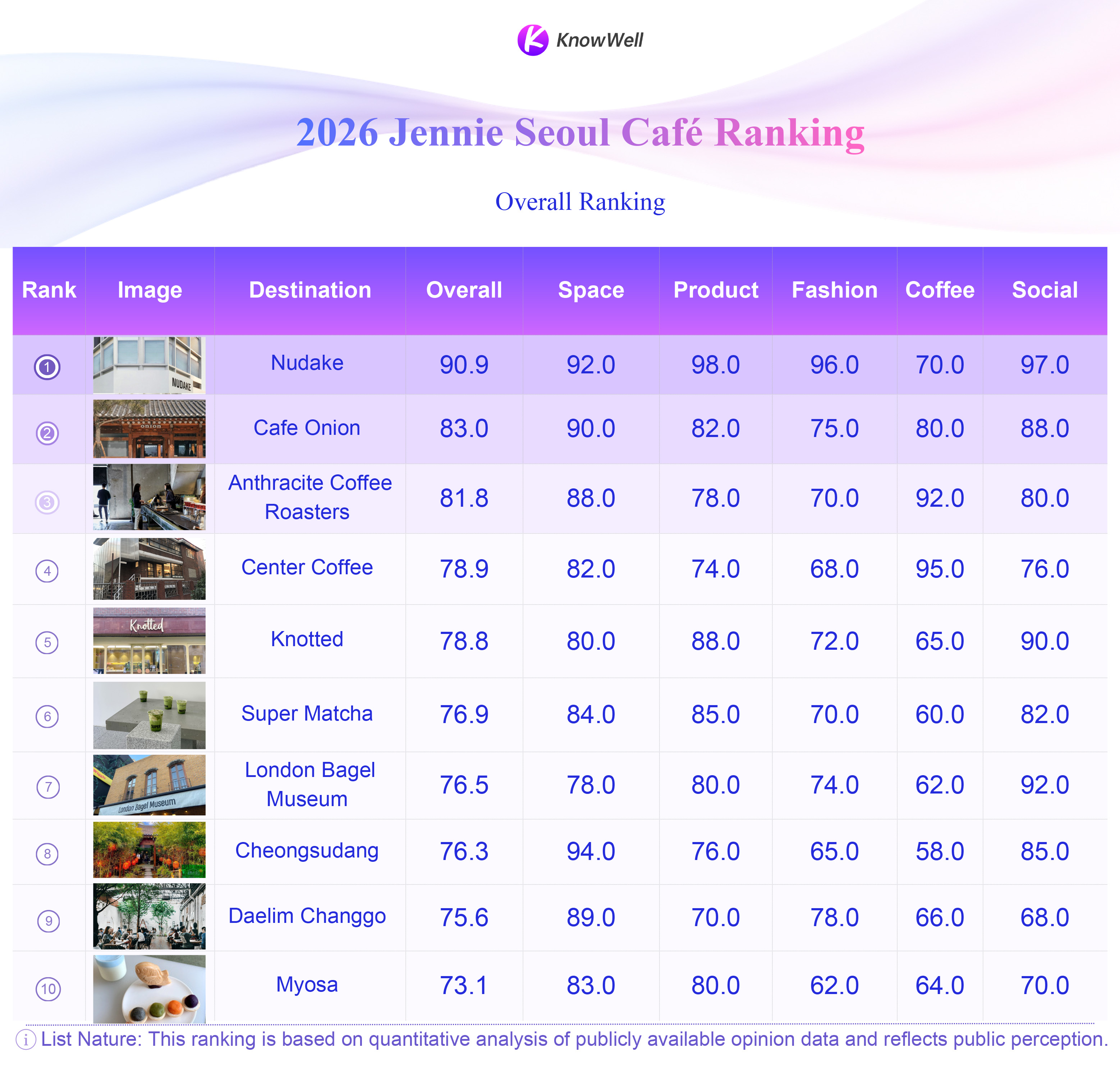
1. Nudake is the runaway leader. It tops product creativity at 98.0, fashion crossover at 96.0 and social visibility at 97.0, giving it the ranking's clearest three-dimensional advantage.
2. Cafe Onion and Anthracite reach industrial chic from opposite directions. One inserts contemporary cafe culture into a hanok; the other preserves the rawness of a former shoe factory around serious roasting.
3. Center Coffee is the ranking's professional counterweight. Its 95.0 coffee score is the category leader, but lower fashion and product-creativity scores keep technical excellence from determining the full order.
4. Seongsu is the geographic center of the list. Five ranked venues are located in or closely tied to the district, reinforcing its role as Seoul's most concentrated cafe-fashion ecosystem.
Top 10 Cafe Highlights
1. Nudake (90.9 points)
Key themes: Sculptural dessert, fashion crossover and monochrome spectacle
Created by the fashion-eyewear company Gentle Monster, Nudake treats dessert as installation art. Its signature Peak cake pairs a black croissant shell with vivid green matcha cream, while the Seongsu location sits within Haus Nowhere alongside Gentle Monster and Tamburins. Roman-style sculpture, black-and-white staging and product drama make the cafe the list's fullest fusion of luxury control and street-fashion provocation.
Where opinions divide: A 70.0 coffee score shows that the concept is driven more by dessert, design and brand theatre than by specialty-coffee leadership.
2. Cafe Onion (83.0 points)
Key themes: Hanok structure, industrial restraint and broad appeal
Cafe Onion's Anguk location places concrete counters and contemporary furniture inside a preserved hanok framework. That collision of old timber and modern cafe culture makes the space a visual expression of high-low styling: familiar, distinctly Korean and deliberately unfinished. Reliable pastries and strong public visibility give the concept enough substance to outlast its photo appeal.
Where opinions divide: Its crossover with fashion culture is indirect; the venue functions more as a design landmark than a brand-led fashion project.
3. Anthracite Coffee Roasters (81.8 points)
Key themes: Factory texture, visible roasting and professional depth
Anthracite's Hapjeong flagship occupies a converted shoe factory where rough surfaces and industrial scale remain visible. The roasting workspace is part of the experience, connecting atmosphere to production rather than using decay as decoration alone. A 92.0 coffee score - second only to Center Coffee - makes it the strongest balance of hard-edged space and specialist credibility.
Where opinions divide: Product creativity and fashion crossover remain secondary to roasting craft, which limits its score in a ranking built around hybrid cultural impact.
4. Center Coffee (78.9 points)
Key themes: Single origin, light roasting and quiet precision
Center Coffee represents the purist route through Seoul's cafe culture. Seasonal single-origin menus and light-roast brewing place the drink itself ahead of theatrical design. Its restrained Seongsu flagship supports that position: visual control is present, but it never asks the room to compete with the cup. The ranking-leading 95.0 coffee score confirms its technical advantage.
Where opinions divide: A 68.0 fashion score and 74.0 creativity score show the trade-off: professional focus creates authority, but less crossover energy.
5. Knotted (78.8 points)
Key themes: Playful pastry, portable visuals and viral reach
Knotted turns cream-filled breads, croissants and character-led packaging into highly shareable objects. The Seongsu location draws on the district's red-brick industrial vocabulary while keeping the product language bright and accessible. An 88.0 creativity score and 90.0 social score make it one of the ranking's clearest examples of dessert designed to travel through feeds as easily as through the city.
Where opinions divide: Its coffee score of 65.0 and mid-table fashion result keep popularity from becoming category leadership.
6. Super Matcha (76.9 points)
Key themes: Matcha, metallic minimalism and machine performance
Super Matcha combines organic matcha and lower-sugar positioning with a metallic, technology-forward space. A robotic arm preparing matcha turns service into a compact performance, giving the Seongsu location an identity that is both clean and sharp. Balanced space and product scores make it the ranking's most futuristic single-category concept.
Where opinions divide: The 60.0 coffee score reflects a matcha-first identity rather than weakness within its chosen specialty.
7. London Bagel Museum (76.5 points)
Key themes: Queue culture, nostalgic interiors and bakery momentum
London Bagel Museum helped turn bagels into one of Seoul's defining cafe queues. Warm bagels, flavored cream cheese and European-vintage styling distinguish its Apgujeong presence from the city's industrial spaces. A 92.0 social score, second only to Nudake, captures the strength of the public ritual surrounding the visit.
Where opinions divide: Demand and recognizability are stronger than its coffee credentials or direct connection to contemporary fashion crossover.
8. Cheongsudang (76.3 points)
Key themes: Traditional dress, immersive staging and reconstructed heritage
Cheongsudang builds an immersive tea experience around Korean traditional dress and a highly staged interior. Its 94.0 spatial score is the ranking's highest, reflecting the intensity of its heritage-inspired visual world. The venue offers a useful parallel to fashion that reworks tradition rather than reproducing it unchanged.
Where opinions divide: A 58.0 coffee score, the lowest in the list, reflects its identity as a themed tea destination rather than a coffee specialist.
9. Daelim Changgo (75.6 points)
Key themes: Warehouse scale, exhibitions and gallery culture
A converted warehouse in Seongsu, Daelim Changgo operates as much like an exhibition venue as a cafe. Photography and art programming give the room a strong gallery connection, while the raw architecture supports its crossover with street and creative culture. It is the list's clearest example of coffee functioning as access to a larger cultural space.
Where opinions divide: Simpler food and drink offerings, along with a 68.0 social score, keep the venue behind more product-driven concepts.
10. Myosa (73.1 points)
Key themes: Korean sweets, minimal space and quiet discovery
Myosa draws on Korean traditional sweets within a restrained, open visual system. Red-bean shaved ice and the geometric Ang Cube series give the menu a crafted quality without the scale or noise of the list's leaders. Its appeal is intimacy: a smaller, more deliberate expression of contemporary Korean cafe design.
Where opinions divide: Limited seating, a quieter location and the lowest fashion-crossover score reduce its reach within this particular ranking.
Three Culture Trends Behind the Ranking
The Strongest Cafes Operate Beyond Coffee
Nudake, Daelim Changgo and Cheongsudang turn the cafe into a fashion environment, gallery or immersive heritage space. Their value lies in combining consumption with a larger cultural scene. Center Coffee demonstrates the opposite model: the drink can remain the center, but the ranking rewards hybridity.
Industrial Style Has More Than One Meaning
Cafe Onion, Anthracite and Seongsu's converted spaces share concrete, brick and visible age, yet the effect changes with context. Hanok contrast creates cultural layering; factory preservation creates technical seriousness; fashion retail turns rawness into theatrical staging.
Virality and Style Leadership Are Different
Knotted and London Bagel Museum show the strength of queue culture and highly shareable products. Their social scores are high, but neither matches Nudake's fashion crossover or Anthracite's coffee expertise. Popularity is one signal in the system, not the final verdict.
Quick Cafe Guide
Preference | Recommended cafes | Why they fit |
Fashion and spectacle | Nudake / Daelim Changgo | Brand theatre, gallery energy and spaces designed as cultural destinations. |
Serious coffee | Center Coffee / Anthracite | The strongest technical scores, expressed through refined and industrial settings. |
Korean spatial contrast | Cafe Onion / Cheongsudang | Two different ways to place traditional references inside a contemporary visit. |
Viral bakery stop | Knotted / London Bagel Museum | Recognizable products, queue culture and strong social-media momentum. |
Quieter discovery | Myosa / Super Matcha | Focused concepts for Korean sweets or technology-forward matcha. |
Future Outlook
This ranking suggests that Seoul's leading cafes are becoming cultural operating systems. Coffee or dessert remains the transaction, but architecture, fashion, retail and exhibition programming increasingly determine why a place enters public memory. Nudake leads because all of those elements reinforce one another.
Seongsu is likely to remain the most visible testing ground. Its industrial building stock and concentration of fashion, beauty and food brands allow concepts to move quickly between pop-up logic and permanent hospitality. The risk is sameness: once raw concrete and gallery staging become expected, product quality and original point of view matter more.
For a Jennie-aligned route, the enduring question is the same one her public fashion image raises: can high refinement and apparent effortlessness coexist? The cafes that answer yes through both product and space will outlast the next viral queue.
List Nature: frontend-text