
Image Credits: frontend-text
Cities & Livability


Top 20 Asia's Leading Cities For Young People
A great city for young adults has to work before it dazzles. Rent must leave room for a life; transport and services must make ordinary days easier; and the city needs places to meet, work, move and stay out late.This ranking compares 20 Asian cities across eight weighted measures drawn from public online discussion. T...
A great city for young adults has to work before it dazzles. Rent must leave room for a life; transport and services must make ordinary days easier; and the city needs places to meet, work, move and stay out late.
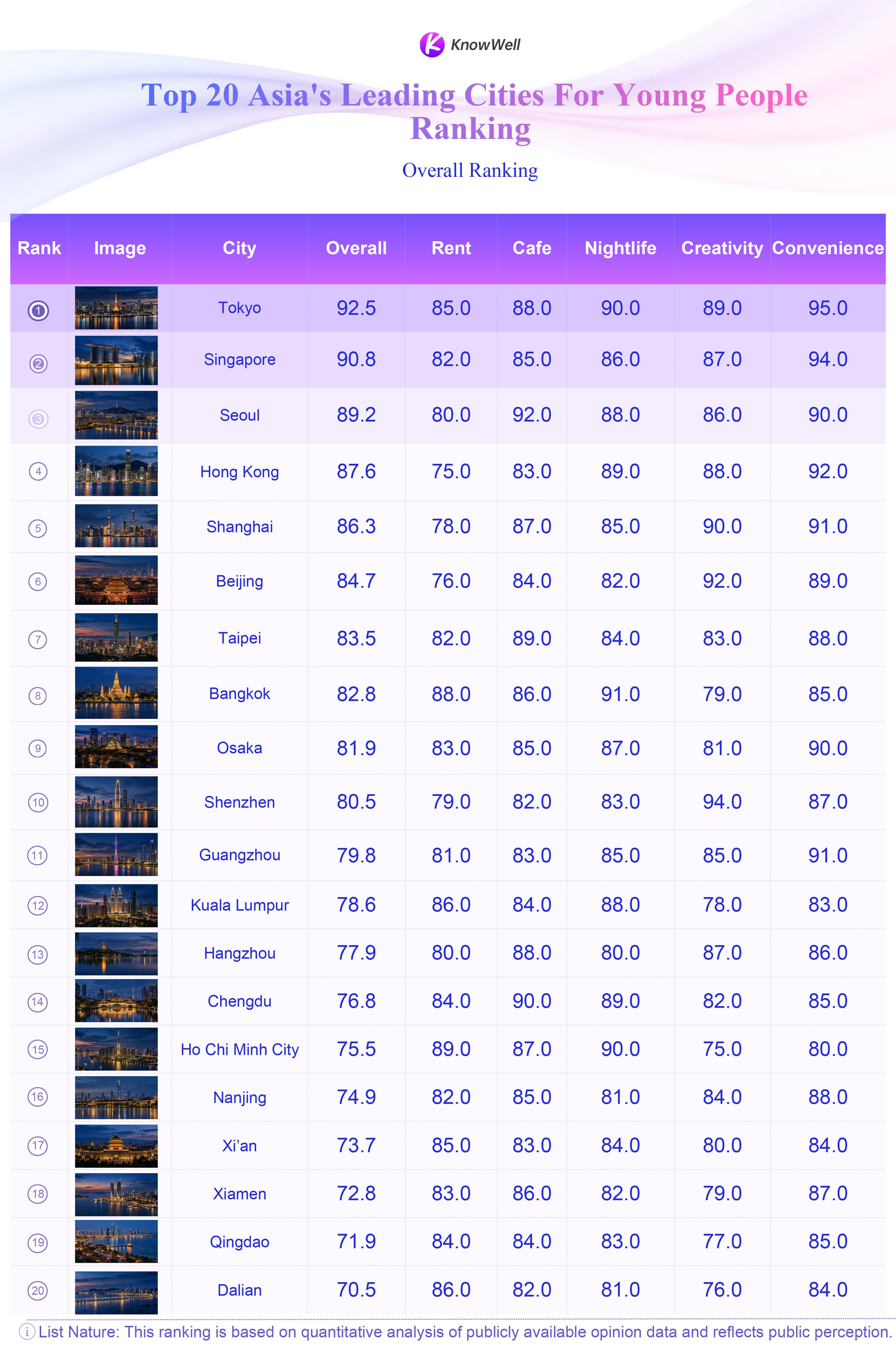
This ranking compares 20 Asian cities across eight weighted measures drawn from public online discussion. Tokyo takes first place with a reported overall score of 92.5, followed by Singapore at 90.8 and Seoul at 89.2.The top ten reveal no single formula. Some cities win on infrastructure, others on nightlife or creative careers. The useful question is not simply which city ranks highest, but which set of strengths best matches the life a young resident wants to build.
Ranking Snapshot
Tokyo ranks first at 92.5. Singapore follows at 90.8, with Seoul at 89.2. Hong Kong and Shanghai complete the top five. Beijing, Taipei, Bangkok, Osaka and Shenzhen round out the top ten. The remaining field runs from Guangzhou in 11th at 79.8 to Dalian in 20th at 70.5.
Top 20 Highlights
1. Tokyo | 92.5
Tokyo turns frictionless daily life into its strongest argument. Everyday Convenience leads the field at 95.0, supported by a 91.0 International Outlook score. The trade-off is housing: its 85.0 Rent Pressure score trails several lower-ranked Southeast Asian cities. The city appeared 1,560 times in the monitored discussion.
2. Singapore | 90.8
Singapore makes the basics feel unusually dependable. Its 94.0 Convenience score ranks second, while International Outlook reaches 93.0, also second. Housing remains the softer point; its 82.0 Rent Pressure score ranks outside the top ten. The city appeared 1,420 times in the monitored discussion.
3. Seoul | 89.2
In Seoul, the cafe is as much workplace and meeting point as coffee stop. Cafe Density scores 92.0, the highest in the ranking, and Social Activity reaches 89.0, third overall. Its 80.0 Rent Pressure score is only 17th, making affordability the clearest constraint. The city appeared 1,380 times in the monitored discussion.
4. Hong Kong | 87.6
Hong Kong’s compact intensity comes with a distinctly international edge. A 94.0 International Outlook score is the ranking’s best, while Convenience at 92.0 places third. Rent Pressure drops to 75.0, the lowest score in the entire ranking. The city appeared 1,250 times in the monitored discussion.
5. Shanghai | 86.3
Shanghai pairs metropolitan polish with a deep creative-work ecosystem. Creative-Industry Opportunity reaches 90.0, third overall, while Convenience scores 91.0. Rent Pressure is the weak link at 78.0, ranking 18th among the 20 cities. The city appeared 1,980 times in the monitored discussion.
6. Beijing | 84.7
Beijing’s opportunity story is strongest where culture and creative work meet. Its 92.0 Creative-Industry Opportunity score ranks second among all 20 cities. A 76.0 Rent Pressure score ranks 19th, sharply tempering its career advantage. The city appeared 1,850 times in the monitored discussion.
7. Taipei | 83.5
Taipei’s appeal lives in the spaces between home and office. Cafe Density reaches 89.0, third overall, and Social Activity scores 87.0. Fitness Spaces is its lowest measure at 81.0, tied in the lower half of the field. The city appeared 980 times in the monitored discussion.
8. Bangkok | 82.8
Bangkok offers the list’s clearest blend of after-dark energy and manageable housing pressure. Nightlife scores 91.0, the highest in the field, and Rent Pressure reaches 88.0, second overall. Fitness Spaces and Creative-Industry Opportunity both sit at 79.0, limiting an otherwise social profile. The city appeared 1,150 times in the monitored discussion.
9. Osaka | 81.9
Osaka’s case is built on ease rather than spectacle. Everyday Convenience scores 90.0, tied for fourth, with Nightlife at 87.0. Fitness Spaces is the soft spot at 80.0, while its broader profile remains steady rather than category-leading. The city appeared 920 times in the monitored discussion.
10. Shenzhen | 80.5
Shenzhen is the ranking’s most forceful career-first proposition. Creative-Industry Opportunity hits 94.0, the highest score in that dimension. Rent Pressure scores 79.0, ranking 17th, and Social Activity is comparatively muted at 82.0. The city appeared 1,650 times in the monitored discussion.
11. Guangzhou | 79.8
Guangzhou makes a practical case through the rhythm of ordinary life. Everyday Convenience reaches 91.0, its strongest result, while Social Activity scores 86.0. International Outlook is the limitation at 79.0, the city’s lowest category score. The city appeared 1,420 times in the monitored discussion.
12. Kuala Lumpur | 78.6
Kuala Lumpur stretches a young resident’s budget without giving up the night. Nightlife scores 88.0 and Rent Pressure reaches 86.0, giving the city two clear lifestyle strengths. Fitness Spaces and Creative-Industry Opportunity both stop at 78.0. The city appeared 890 times in the monitored discussion.
13. Hangzhou | 77.9
Hangzhou’s strongest spaces sit between digital work and cafe culture. Cafe Density reaches 88.0, while Creative-Industry Opportunity scores 87.0. International Outlook falls to 76.0, leaving its global profile behind its creative credentials. The city appeared 1,350 times in the monitored discussion.
14. Chengdu | 76.8
Chengdu turns sociability into a defining urban asset. Social Activity reaches 91.0, the highest mark in its profile, with Cafe Density at 90.0. International Outlook drops to 74.0, the clearest counterweight to its social strength. The city appeared 1,280 times in the monitored discussion.
15. Ho Chi Minh City | 75.5
Ho Chi Minh City runs on late hours, low barriers and visible street energy. Nightlife reaches 90.0 and Rent Pressure scores 89.0, the best affordability result in the field. Creative-Industry Opportunity is the weak point at 75.0, with Fitness Spaces close behind at 76.0. The city appeared 760 times in the monitored discussion.
16. Nanjing | 74.9
Nanjing offers a measured, functional version of city life. Everyday Convenience leads its profile at 88.0, backed by Cafe Density at 85.0. International Outlook is its lowest measure at 75.0, limiting its reach beyond the domestic context. The city appeared 1,120 times in the monitored discussion.
17. Xi’an | 73.7
Xi’an’s clearest advantage is the room it leaves in a housing budget. Rent Pressure reaches 85.0, while Social Activity also scores 85.0. International Outlook falls to 72.0, the lowest score in its profile. The city appeared 980 times in the monitored discussion.
18. Xiamen | 72.8
Xiamen favors a gentler daily pace anchored by cafes and convenience. Everyday Convenience scores 87.0 and Cafe Density follows at 86.0. Creative-Industry Opportunity is the soft spot at 79.0. The city appeared 850 times in the monitored discussion.
19. Qingdao | 71.9
Qingdao’s appeal is steady rather than spectacular. Everyday Convenience reaches 85.0, narrowly ahead of its 84.0 Rent Pressure and Cafe Density scores. International Outlook scores 76.0 and Creative-Industry Opportunity 77.0, both well below its daily-life measures. The city appeared 920 times in the monitored discussion.
20. Dalian | 70.5
Dalian closes the list with a housing-value proposition. Rent Pressure reaches 86.0, its strongest category score. International Outlook is the constraint at 73.0, while Creative-Industry Opportunity reaches only 76.0. The city appeared 790 times in the monitored discussion.
What Ties Them Together
The leaders make daily life legible. Tokyo, Singapore and Hong Kong all pair top-four Convenience scores with top-four International Outlook scores. Seoul and Taipei take a different route, converting cafe culture and social energy into a strong everyday proposition. Bangkok stands out for nightlife and housing value, while Shanghai, Beijing and Shenzhen pull career opportunity to the center of the decision.
That mix matters because no city dominates every measure. The ranking rewards balance, but the underlying scores expose the compromises: several career-rich cities place near the bottom on Rent Pressure, while the strongest housing-value cities often give up ground in international reach or creative-industry depth.
The Bottom Line
Tokyo is the strongest all-round choice in this dataset, but it is not the automatic answer for every young person. Choose Singapore or Hong Kong for global connectivity, Seoul or Taipei for cafe-led social culture, Bangkok for nightlife and relative housing value, and Shenzhen or Beijing when creative-industry opportunity carries the most weight. The best city is the one whose weakness you can live with.
List Nature: frontend-text