


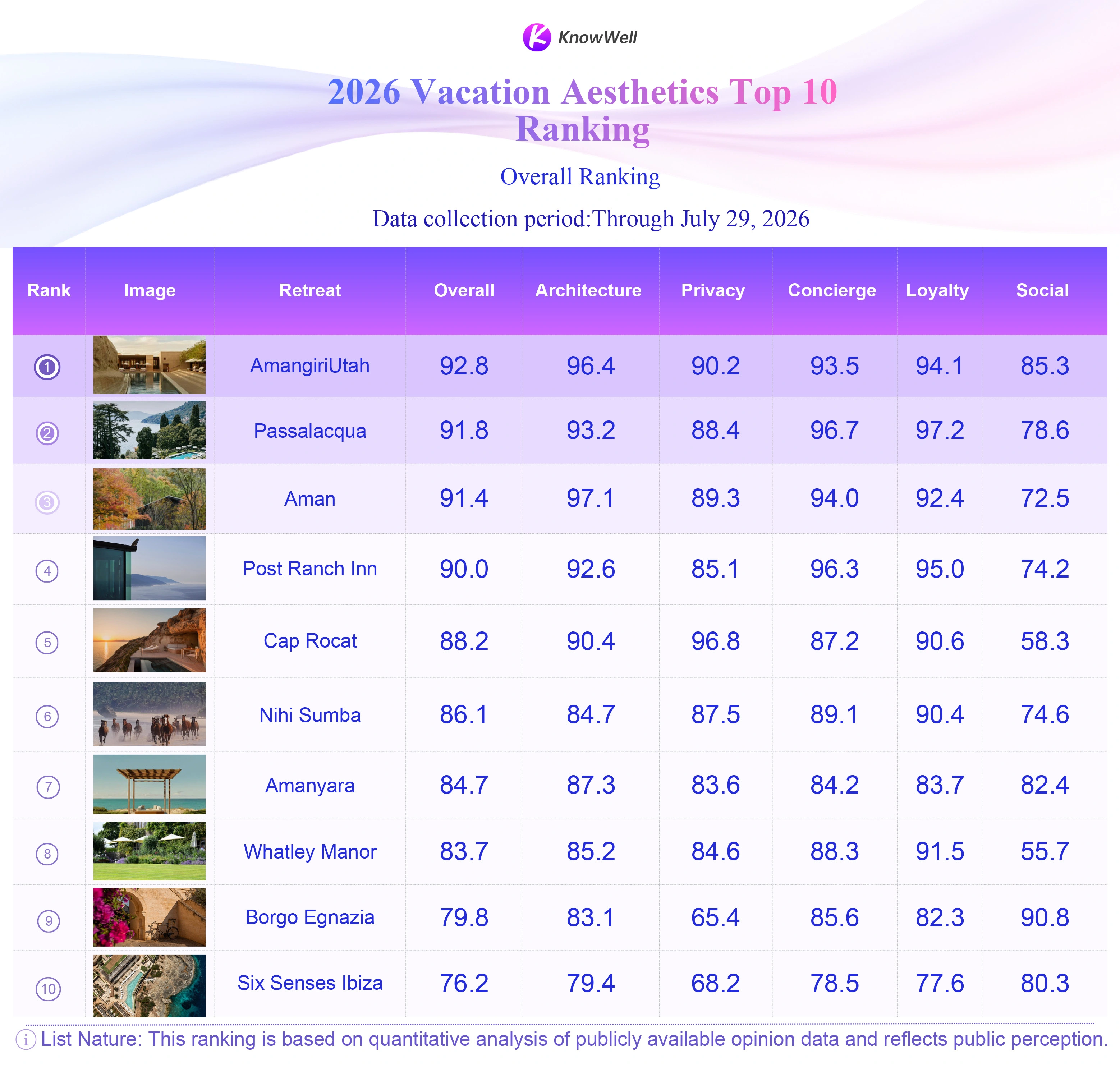
Borgo Egnazia draws more social attention than any other property in this ranking—and provides its clearest reminder that visibility is not the same as desirability. Its 90.8 social score leads the field by 5.5 points over the next property, yet it finishes ninth overall, held down by a 65.4 privacy score, the lowest here. That gap defines the central tension behind this list: attention can be bought at scale, while discretion can only be protected.
The running order rewards silence. Amangiri takes first place with 92.8 because nothing in its profile falls away—96.4 for architecture, 90.2 for privacy, 93.5 for concierge, 94.1 for loyalty. Below it, Cap Rocat posts the field's highest privacy score, 96.8, and still lands fifth, which is how a weighted result behaves when one extreme outperforms and four dimensions merely hold. What separates the top of this ranking from the bottom is not decor but geography: how long the approach is, how many guests are allowed in, and how hard arrival is to arrange.
Ranking Snapshot
1. Amangiri wins because nothing falls away. Second in architecture, second in privacy and third in loyalty, it has no weak dimension to trade against the others. It is the clearest all-rounder here.
2. Second and third are separated by four-tenths of a point for opposite reasons. Passalacqua leads concierge depth and loyalty; Aman Kyoto leads architecture. The near tie hides two different ideas about what a retreat is for.
3. Cap Rocat posts the highest privacy score in the field, 96.8, and finishes fifth. Seclusion alone cannot lift a weighted result when architecture ranks fifth and social visibility second lowest.
4. Borgo Egnazia is the visibility trap. Top of the social dimension, ninth overall, and last in privacy: this ranking rewards restraint about exposure, not success at it.
Top 10 Retreat Highlights
1. Amangiri — Utah, United States (92.8 points)
Key traits: Concrete, red rock and vanishing outlines
Aman's North American flagship turns restraint into a building method: board-formed concrete, dark steel and Douglas fir settle into Utah's red-rock desert until the structure reads as a shadow line rather than a landmark. Its 96.4 architecture score is second in the field. Thirty-four suites sit inside 900 acres of private conservation land reachable only by a gated road, and that gate is part of the product. Butlers work to each guest's rhythm—a private concert under desert stars, a canyon walk timed to low light—rather than to a schedule printed in advance.
Where the trade-offs show: Its 85.3 social score is the second highest here. A retreat that becomes the standard example of discretion attracts visitors who want to check.
2. Passalacqua — Moltrasio, Lake Como, Italy (91.8 points)
Key traits: Twenty-four keys, a private boat, no formal dining room
An eighteenth-century villa on the quieter western shore of Lake Como, Passalacqua keeps its scale deliberately small: twenty-four suites, terraced gardens, a boat on call. Where the desert properties build scarcity out of landscape, this one builds it out of staffing. A dedicated driver and a gardener who cuts the flowers each morning add up to care that is hard to point at. There is no single formal restaurant—guests eat in the garden, on the terrace or beside the water, and that decision sets the pace for the whole stay. It leads both concierge depth (96.7) and loyalty (97.2).
Where the trade-offs show: Privacy ranks fourth rather than first. A lakeside villa is near other people by definition; the seclusion is managed, not absolute.
3. Aman Kyoto — Kyoto, Japan (91.4 points)
Key traits: Wabi-sabi, moss, and silence as a service standard
Hidden at the foot of Mount Daimonji inside a private garden, this late Kerry Hill design takes wabi-sabi as an operating principle rather than a palette: timber, tatami, paper screens, very little else. It earns the field's highest architecture score, 97.1. Twenty-six rooms sit apart in the trees, none visible from another. Service follows Japanese hospitality logic—precise, unhurried, almost never announced. Its 72.5 social score is third lowest in the ranking, which this framework reads as evidence rather than weakness: places that expect to be found have little reason to advertise.
Where the trade-offs show: Discovery runs on word of mouth, and its minimal footprint means fewer facilities than the score alone suggests.
4. Post Ranch Inn — Big Sur, California, United States (90.0 points)
Key traits: Cliffs, no televisions, no alarm clocks
Set above Highway One on the Big Sur cliffs, the property is built from reclaimed timber, glass and stone, and it edits rather than accumulates: no televisions, no alarm clocks, no reason to watch the clock. It carries a Three Keys classification in the 2026 Michelin Guide. Its 96.3 concierge score is second in the field, built on itineraries arranged around tides and moon phases—stargazing from the room, sound sessions after dark, a guide who knows which trail will be empty. With no light pollution nearby, darkness is the amenity.
Where the trade-offs show: Privacy scores sixth. The view is public property in a way a walled peninsula is not, and the highway below never leaves.
5. Cap Rocat — Mallorca, Spain (88.2 points)
Key traits: A sea fort that kept its gun ports
A nineteenth-century coastal fortress converted with unusual restraint, Cap Rocat occupies a protected private peninsula in the Bay of Palma and keeps its original brickwork and gun embrasures. Thirty rooms. Guests arrive over a drawbridge and through a tunnel cut into the old ramparts, so arrival itself stays under the property's control. Reviewers keep reaching for the same phrase—understated luxury—and here it describes rather than promotes. It posts the field's highest privacy score, 96.8, nearly seven points clear of the next property.
Where the trade-offs show: Its 58.3 social score is second lowest and its architecture score, 90.4, ranks fifth. Privacy alone cannot carry a weighted result.
6. Nihi Sumba — Sumba, Indonesia (86.1 points)
Key traits: Barefoot luxury with a long approach
Often cited as the reference point for barefoot luxury, Nihi Sumba sits on an undeveloped stretch of Sumba's coast with roughly eighty guests on property at capacity. Rooms drop the television and substitute open-sided structures in local materials, a private host, a world-class break offshore and an island foundation that predates the hotel's arrival. Review language keeps circling one idea: refinement concealed inside simplicity. Under a framework that rewards restricted access, remote islands like this one climb well above the positions they hold in traffic-driven lists.
Where the trade-offs show: Reaching it costs a connection and a long transfer, and its 84.7 architecture score is eighth here—the simplest buildings in the top six.
7. Amanyara — Turks and Caicos Islands (84.7 points)
Key traits: Minimal pavilions across eighteen thousand acres
Pavilions and villas in pale timber sit inside an 18,000-acre nature reserve, sparse enough that reviewers describe it as having no surplus infrastructure at all. The architectural language carries Aman's restraint without effort, and the setting absorbs everything else. Recent years have brought repeated celebrity use as a filming and holiday location; its 82.4 social score is third highest in the field. Attention of that kind taxes the thing being sold: privacy, at 83.6, ranks only eighth.
Where the trade-offs show: Visibility is working against the asset here. The same exposure that fills rooms thins out the seclusion guests arrive for.
8. Whatley Manor — Cotswolds, United Kingdom (83.7 points)
Key traits: Fireplaces, a library, an English garden
A Cotswolds manor built around fireplaces, a library and formal gardens, Whatley Manor is the entry here closest to the register made familiar by the Cotswolds house David Beckham and Victoria Beckham keep: quiet tailoring translated into built form. Its 91.5 loyalty score ranks fifth, evidence of a repeat clientele rather than a passing one. Staff can name regular guests and their habits, which is harder to engineer than any design choice.
Where the trade-offs show: Its 55.7 social score is the lowest in the ranking and privacy ranks seventh. A manor in the English countryside is easy to reach, and easy reach puts a ceiling on privacy.
9. Borgo Egnazia — Puglia, Italy (79.8 points)
Key traits: An Apulian village rebuilt as a stage set
Built as an interpretation of a traditional Apulian village, Borgo Egnazia runs on whitewashed lanes and candlelit courtyards that reviewers keep calling cinematic. Its 90.8 social score tops the ranking. Then the arithmetic turns: celebrity weddings, international events and a large room count pull privacy down to 65.4, the lowest score in the field. Charm here is not in question. Seclusion is what was spent to produce it.
Where the trade-offs show: It is the easiest property here to photograph and the hardest to disappear in. Those two facts describe the same thing.
10. Six Senses Ibiza — Ibiza, Spain (76.2 points)
Key traits: Northern bays, local craft, vintage furniture
On the quieter northern side of Ibiza, the property mixes local building craft with mid-century furniture, and reviews return to the same two words: understated, atmospheric. Its 80.3 social score is fourth highest in the ranking. The weighted result suffers elsewhere: at 79.4 for architecture, 68.2 for privacy and 78.5 for concierge, it is the only retreat here sitting outside the top six on all three at once.
Where the trade-offs show: Scale and high-season pressure make service uneven; whatever keeps it visible also keeps it busy.
Three Patterns Behind the Ranking
Location Is the Luxury Language
Architecture and privacy together carry 55% of the weight, so geography outranks decoration. Amangiri, Cap Rocat and Aman Kyoto do not share a style; they share a condition. Each is difficult to reach and impossible to stumble into, and that difficulty is what the scores are actually measuring.
Service Is Best When Nobody Notices It
Concierge depth separates quietly: Passalacqua leads at 96.7, Post Ranch Inn follows at 96.3, and neither property advertises the machinery. A boat arranged before the question is asked, a walk timed to the moon. The retreats at the top treat coordination as invisible labour rather than as a performance of care.
Visibility Spends Discretion
Social visibility carries only 10% of the weight, and the results justify it. Borgo Egnazia leads that dimension and finishes ninth. Whatley Manor posts the lowest score in the field, 55.7, and still reaches eighth. Amanyara's rising exposure reads as a warning rather than an achievement: the broader the reputation grows, the less it can promise.
Quick Retreat Guide
Trip Purpose | Retreats | Why They Fit |
Absolute discretion | Cap Rocat / Nihi Sumba | A drawbridge and an eighty-guest island decide who arrives long before anyone checks in. |
Architecture as the reason to go | Aman Kyoto / Amangiri | The two highest architecture scores here, reached by opposite philosophies. |
Service that never announces itself | Passalacqua / Post Ranch Inn | The field's top two concierge scores: itineraries built around tides, boats and gardens. |
European familiarity | Passalacqua / Whatley Manor | Old-world settings close to where travellers already are. Privacy is the compromise. |
A first step into quiet luxury | Amanyara / Six Senses Ibiza | Easier to book, easier to photograph—and scored down here for exactly that. |
Future Outlook
The aesthetic described here is moving from a palette to a policy. For most of the past decade, quiet luxury was recognised by sight: neutral linen, untreated oak, no logo in frame. What separates these ten properties is not how they look but what they refuse—how many guests, how much access, how much of themselves they allow to circulate.
That shift has consequences for the properties themselves. Discretion is a depreciating asset: every booking made because a place is hard to get into makes the next one slightly easier, and the habit of converting scarcity into content erodes exactly what the scarcity was worth. Amanyara, whose 82.4 social score is third highest here, sits closest to that line.
It also reframes what a traveller is buying. The top of this list demands effort—a gated road, a boat across water, a long island transfer—while the bottom offers the same aesthetic at arm's length. The interesting question for 2027 is not which retreats look quiet. It is which ones are still structurally able to be.
List Nature: frontend-text