


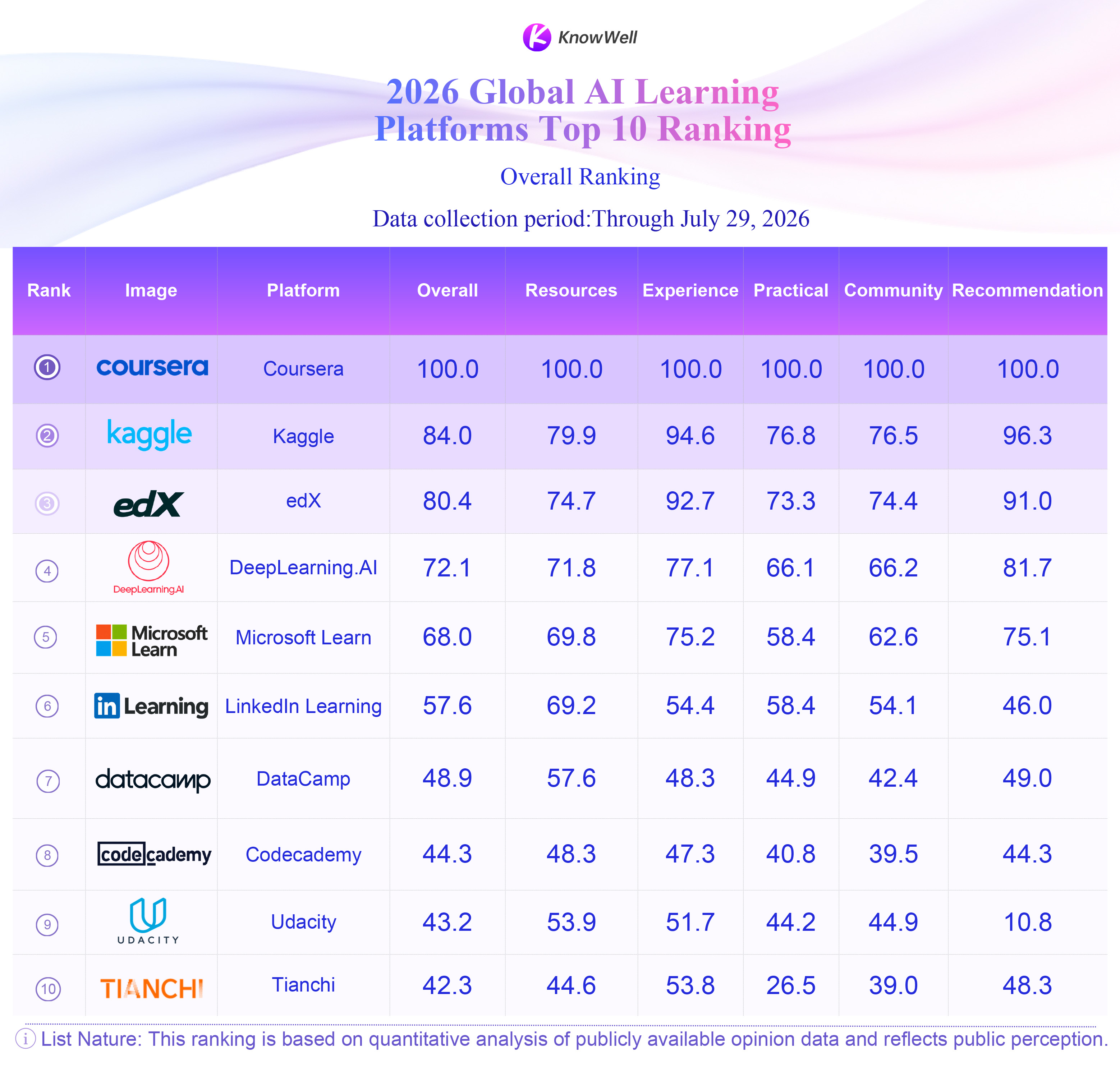
Coursera leads every dimension here at 100.0 — and that is the number to interrogate first. These are indexed scores, scaled against the sample leader, so 100.0 means category leadership within ten platforms, not a flawless product. What actually explains this list sits further down. Kaggle and edX concede twenty to twenty-five points on resources and still take second and third, carried by experience scores of 94.6 and 92.7 and recommendation scores of 96.3 and 91.0. Udacity shows what happens when those two pull apart: 53.9 on resources, then 10.8 on recommendation, the lowest figure anywhere in the table. LinkedIn Learning repeats it at a calmer scale — resources 69.2, recommendation 46.0 — which is what turns an outlier into a pattern. Resources decide what a platform can teach. Practice, community and advocacy decide who stays.
The analysis compares ten platforms across learning resources, learning experience, practical value, community influence and user recommendation. The overall score weights those dimensions at 25%, 20%, 20%, 20% and 15%. All scores represent relative performance within the same public-discussion model and should not be read as absolute ratings of course quality, employment outcomes or market share.
Ranking Snapshot
1. Coursera wins through completeness. Every dimension reaches 100.0; its advantage is not one exceptional category, but the absence of a visible weakness.
2. Kaggle and edX form a clear second tier. Both separate themselves through strong experience and recommendation scores, but Kaggle is built around practice and community while edX is built around structured courses.
3. Microsoft Learn's position understates its value to a specific audience. It ranks fifth overall, but may be the most direct first choice for Azure AI, Copilot and enterprise deployment learners.
4. Udacity is the ranking's largest reputation warning. Its resources, experience and practice scores remain mid-table, while its 10.8 recommendation score falls sharply behind every other platform.
Top 10 Platform Highlights
1. Coursera (100.0 points)
Key themes: Course breadth, learning pathways and global partnerships
Coursera does not win through a single advantage. It pushes course supply, user experience, project value, community visibility and recommendation intent to the top of this ranking at the same time. Partnerships with universities and technology companies create a path from machine-learning foundations to generative AI, data science and professional certificates. Five scores of 100.0 make it the sample's clearest all-round choice.
Where opinions divide: A perfect score means relative leadership inside this sample. It does not mean every course is superior, and it cannot replace an individual assessment of price, teaching language or certificate value.
2. Kaggle (84.0 points)
Key themes: Competitions, real-world data and developer community
Kaggle places learning directly inside datasets, notebooks and competitions. Its 94.6 learning-experience score and 96.3 recommendation score both rank second, showing the influence of practical feedback and community examples on learning decisions. It best serves learners who know the fundamentals and want to test their ability through visible work and competitive results.
Where opinions divide: Practice is abundant, but curricular continuity and guided instruction are weaker than on comprehensive platforms. Competition alone can also leave gaps in a learner's knowledge structure.
3. edX (80.4 points)
Key themes: University courses, rigorous structure and credentials
edX builds stable academic credibility through university-led courses. A 92.7 learning-experience score and 91.0 recommendation score show that formal structure has not come at the expense of usability. Unlike Kaggle, it does not put competition at the center; it earns trust through complete courses, clear prerequisites and relatively formal credential pathways.
Where opinions divide: Academic pacing and longer courses can raise the completion barrier. The value of a credential also depends on the institution, program and employment context.
4. DeepLearning.AI (72.1 points)
Key themes: Deep learning, generative AI and specialist pathways
DeepLearning.AI trades breadth for a distinct professional focus. Courses associated with Andrew Ng, short programs on generative AI and clearly defined skill paths recur throughout public discussion. Its resource scale is smaller than that of comprehensive platforms, but an 81.7 recommendation score shows that specialism is an advantage for people who want to learn AI rather than general technology skills.
Where opinions divide: Coverage is narrower. Learners seeking university credit, broad electives or a large general-purpose community may still need to combine it with another platform.
5. Microsoft Learn (68.0 points)
Key themes: Azure AI, Copilot and enterprise ecosystems
Microsoft Learn connects study goals directly to Azure AI, Copilot and enterprise deployment. Its 69.8 resource score and 75.2 experience score reflect the pathway advantage created by a mature product ecosystem. For people entering the Microsoft stack or managing organizational AI applications, its practical relevance may be stronger than its overall position suggests.
Where opinions divide: The knowledge base is closely tied to Microsoft products. Its usefulness narrows when the goal is model research, cross-cloud capability or vendor-neutral foundations.
6. LinkedIn Learning (57.6 points)
Key themes: Career skills, workplace AI and short courses
LinkedIn Learning's strength is not advanced model training, but the placement of AI tools inside office work, management and career development. A 69.2 resource score remains competitive, making the platform useful for learners who want to add workplace skills quickly through short, continuous study.
Where opinions divide: Its 46.0 recommendation score trails its resource performance, suggesting that course volume has not automatically created strong advocacy. Advanced technical learners may also find the depth limited.
7. DataCamp (48.9 points)
Key themes: Python, data science and interactive practice
DataCamp uses in-browser exercises to lower the starting barrier for programming and data analysis. Clear course structure and immediate feedback make it especially useful for beginners developing working familiarity with Python, SQL and machine learning. It functions more like an executable training path than a content library.
Where opinions divide: None of its five dimension scores enters the leading tier. Interactive exercises help learners begin, but complex, open-ended projects still need to be completed in a real development environment.
8. Codecademy (44.3 points)
Key themes: Coding foundations, interactive learning and Python
Codecademy extends its established interactive teaching model into a low-friction entry point for AI learners who do not yet have a coding foundation. Its 47.3 experience score slightly exceeds its broader performance, suggesting that the product mechanism still has appeal. It works best as a programming preparation stage before deeper AI study.
Where opinions divide: A 40.8 practical-value score and 39.5 community score limit its position. After completing the foundations, learners will usually need to move toward more realistic projects.
9. Udacity (43.2 points)
Key themes: Nanodegrees, project-based learning and career training
Udacity retains a recognizable project-based identity. Scores of 53.9 for resources, 51.7 for experience and 44.2 for practical value show that its course foundation has not disappeared. But its 10.8 recommendation score is the lowest in the ranking and its most important fault line: historical brand influence is not translating into comparable advocacy in current public discussion.
Where opinions divide: The low recommendation score may reflect price, product changes or discussion volume. It cannot prove a decline in course quality by itself, but it is a strong reason to verify current courses and services before paying.
10. Alibaba Cloud Tianchi (42.3 points)
Key themes: Algorithm competitions, Chinese-language community and enterprise data
Tianchi uses the Alibaba Cloud ecosystem to provide algorithm competitions, datasets and enterprise problems for Chinese-speaking learners. Its 53.8 experience score and 48.3 recommendation score exceed its overall position, showing that participation and localization have real appeal. For learners targeting Chinese competitions and industry settings, it may be more useful than its global rank implies.
Where opinions divide: Its 26.5 practical-value score appears counterintuitive and may show that the keyword system and public-discussion sample are more sensitive to international content. Limited global visibility also weighs on the community dimension.
Three Learning Trends Behind the Ranking
More Resources Do Not Guarantee Stronger Recommendation
LinkedIn Learning and Udacity both reveal the distance between content supply and reputation. A large catalog improves discoverability, but it does not automatically solve pricing, completion experience, update speed or learning outcomes. Recommendation acts like a combined vote: users judge not only what they learned, but whether the investment was worthwhile.
Practice Is Becoming an Entry Point Rather Than an Add On
Kaggle's second-place finish shows that projects, competitions and community feedback have moved from post-course exercises to the first point of entry for many AI learners. Tianchi's experience and recommendation scores also exceed its practical-value score, suggesting that the perceived value of competition platforms is sensitive to language, region and keyword design.
Ecosystem Platforms Depend on Goal Fit
Microsoft Learn, DeepLearning.AI and Tianchi do not win by trying to serve everyone. They build their advantages around an enterprise technology stack, specialist AI education and a Chinese-language competition ecosystem. For learners with a precise goal, platform fit often matters more than the overall rank.
Quick Learning Guide
Learning Goal | Recommended Platforms | Why They Fit |
First structured AI program | Coursera / edX | Complete learning paths with leading resource and experience scores. |
Build practical project skills | Kaggle | Competitions, datasets and community feedback create a rapid practice loop. |
Study deep learning and generative AI | DeepLearning.AI | A clear specialist focus with strong recommendation among vertical platforms. |
Enter the Microsoft enterprise stack | Microsoft Learn | Direct links to Azure AI, Copilot and deployment scenarios. |
Build Python and data foundations | DataCamp / Codecademy | Interactive exercises lower the entry barrier to programming. |
Join Chinese algorithm competitions | Alibaba Cloud Tianchi | Localized access to enterprise problems, datasets and a Chinese-language ecosystem. |
Future Outlook
This ranking suggests that competition among AI learning platforms has moved from whether courses exist to whether courses produce completion, practice and recommendation. Coursera leads because content, product design, projects and community reinforce one another. Kaggle and edX show that practical intensity and academic structure can both create strong, but very different, learning paths.
The next shift is most likely to come from ecosystem platforms. As generative AI tools change faster, Microsoft Learn and DeepLearning.AI will be judged on how quickly they convert technical change into stable coursework. Udacity faces a more direct task: rebuild recommendation intent so that project-based learning once again produces visible user advocacy.
For learners, the most reliable approach is not to follow the overall rank mechanically, but to define the goal first: structured study, practical projects, career transition, enterprise deployment or competition training. The overall score narrows the field; dimension scores and platform fit should determine the final choice.
List Nature: frontend-text