


The Odyssey earns the highest production score in this ranking—and provides its clearest reminder that spectacle alone does not determine the final order. Overseas discussion gives the film an 8.6 for production, reflecting strong attention to its large-format filmmaking, practical locations and the scale of its mythic adaptation. Yet it finishes only fourth overall, with a narrative score of 6.8 and a long-term value score of 5.4. That gap defines the central tension behind this list: scale may win immediate attention, but lasting status depends on whether spectacle, character and emotional consequence ultimately reinforce one another.
The analysis covers 2,200 imported records and 1,252 deduplicated discussion excerpts from Facebook, X, TikTok, YouTube and international media. Attention is not treated as a substitute for quality. Instead, each film is compared across overall reception, narrative, production, performance and long-term value.
Ranking Snapshot
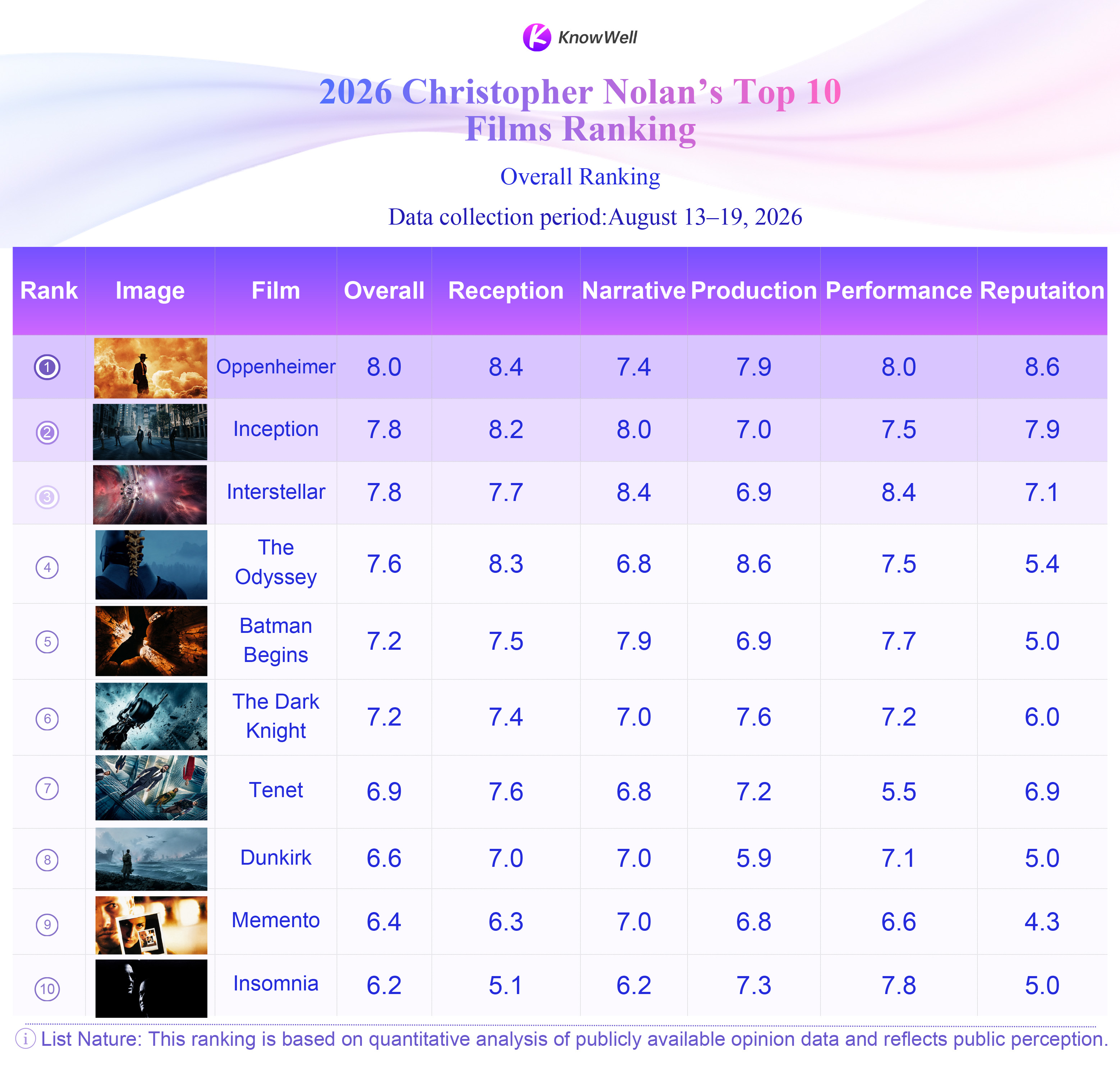
1. Oppenheimer wins because it has no obvious weakness. Its 8.4 reception score and ranking-leading 8.6 long-term score combine immediate approval with durable value. It is the list's clearest all-rounder.
2. Inception and Interstellar tie - for opposite reasons. Inception leads through conceptual control and rewatchability; Interstellar through narrative, performance and emotional force. The equal score hides two very different kinds of audience loyalty.
3. The Dark Knight at No. 6 is the ranking's biggest provocation. The result reflects balanced scores in this specific discussion sample, not a downgrade of its critical reputation or historical influence.
4. The Odyssey is the production leader and the new-release wild card. Its 8.6 production score tops the list, while a 5.4 long-term score shows that event-level excitement has not yet matured into lasting consensus.
Top 10 Film Highlights
1. Oppenheimer (8.0 points)
Key themes: Themes, ethics and performance
Nolan's historical epic places personal choice, state power and moral consequence inside the same narrative machine. Its strongest advantage is consistency: overall reception, performance and long-term value all remain high. Overseas discussion repeatedly points to the film's thematic density, structural control and the pressure generated by its ensemble performances.
Where opinions divide: Dialogue density, emotional distance and the information-heavy final stretch remain the main sources of criticism.
2. Inception (7.8 points)
Key themes: Dreams, structure and rewatch value
Its rules are clear enough to follow and durable enough to reward repeated viewing. Layered dream architecture, cross-cutting, audiovisual design and the unresolved ending continue to drive discussion. More than a decade later, it remains one of the most accessible ways into Nolan's filmmaking: intellectually ambitious, but powered by a clean genre engine.
Where opinions divide: Some viewers find the explanatory dialogue excessive, while the emotional relationship is less convincing than the structure built around it.
3. Interstellar (7.8 points)
Key themes: Family, time and music
The film combines family separation, the experience of time and cosmic scale into Nolan's most immediate emotional memory. Music, cinematography, spatial design and emotional momentum appear frequently in positive discussion. Its narrative and performance scores are joint category leaders, suggesting that feeling is not merely attached to the spectacle - it is the engine of it.
Where opinions divide: Sentimentality, direct dialogue and the way scientific ideas are explained continue to divide audiences.
4. The Odyssey (7.6 points)
Key themes: IMAX, location shooting and mythic adaptation
Large-format production, practical locations and the scale of mythic retelling have made the film feel like a collective viewing event. It earns the ranking's highest production score at 8.6. Action, spatial staging and the attempt to return an ancient story to contemporary culture dominate positive discussion.
Where opinions divide: A 6.8 narrative score and 5.4 long-term score show clear debate around dialogue, adaptation choices and emotional access. As a new release, its final standing is still taking shape.
5. Batman Begins (7.2 points)
Key themes: Character arc, Gotham and atmosphere
Rather than rushing toward the arrival of a superhero, the film rebuilds Bruce Wayne's motivation and Gotham's social texture from the ground up. Character development, realism and atmosphere are treated as lasting strengths. It may not be the trilogy's loudest entry, but it is the foundation that makes the later films possible.
Where opinions divide: The pace loosens in the second half, and the third act is viewed as less controlled than the film's opening sections.
6. The Dark Knight (7.2 points)
Key themes: Crime drama, antagonist and moral conflict
The film pushes superhero cinema toward crime thriller and moral parable. Its antagonist and ethical dilemmas remain the most durable focus of overseas discussion. Sixth place should not be mistaken for an assessment of its place in film history: in this sample, its five dimensions are balanced rather than dominated by one exceptional category.
Where opinions divide: This ranking compares quality signals inside one public-discussion sample; it does not measure critical canon or historical influence.
7. Tenet (6.9 points)
Key themes: Time inversion, action and sound
Time-inverted action and an unusually forceful soundscape give the film a distinct identity. Its formal impact keeps overall reception and long-term discussion relatively resilient. This is Nolan at his most willing to ask audiences to experience the mechanism before fully understanding it.
Where opinions divide: A performance score of 5.5, the lowest in the ranking, reflects the emotional distance many viewers feel beneath the conceptual load.
8. Dunkirk (6.6 points)
Key themes: Time, space and sound
Traditional exposition is compressed into an experience of survival across three timelines. Editing and sound carry the emotional function usually assigned to dialogue. The film's power comes from sensory order rather than explanation.
Where opinions divide: Its 5.9 production score in this sample suggests that the film's severe formal choices are not universally read as strengths, despite their technical precision.
9. Memento (6.4 points)
Key themes: Nonlinearity, memory and identity
The nonlinear structure is not decoration; it is the viewing mechanism. Audiences lose their causal bearings alongside the protagonist, giving the themes of memory and identity unusual force. It remains a key work for understanding Nolan's fascination with structure.
Where opinions divide: The lower long-term score reflects relative comparison within this particular sample, not a claim that the film lacks historical influence.
10. Insomnia (6.2 points)
Key themes: Moral fatigue, atmosphere and performance
Without a large-scale conceptual hook, the film succeeds through restraint and psychological pressure. Its 7.8 performance score is the second highest in the ranking. Moral exhaustion and compromised judgment reveal a quieter side of Nolan's filmography.
Where opinions divide: A 5.1 overall reception score pulls down the result, indicating weaker broad recommendation within this sample.
Three Audience Trends Behind the Ranking
Structure Is Not the Same as Emotion
Memento and Inception show how formal innovation can sustain long-tail discussion. Interstellar and Oppenheimer go one step further by converting structure into character, responsibility and emotional consequence.
Scale Is a Double-Edged Advantage
IMAX, practical production and sound design are shared Nolan assets. They also raise expectations for dialogue, character and narrative clarity. The bigger the canvas becomes, the more audiences ask whether the people remain at its center.
New Releases Are Seen as Events First
Discussion of The Odyssey begins with production stories, mythic adaptation and the theatrical experience. It has already proved its cultural-event appeal, but repeat viewing and comparison will determine its lasting position.
Quick Viewing Guide
Viewer Preference | Recommended Films | Why They Fit |
First Nolan film | Inception / Interstellar | Accessible entry points with strong genre appeal and memorable emotion. |
Structural puzzles | Inception / Memento | One is a commercial spectacle; the other a concentrated formal experiment. |
Character and emotion | Interstellar / Oppenheimer | Family, responsibility and choice sit in front of the large-scale ideas. |
Big-screen experience | The Odyssey / Dunkirk | IMAX, sound and spatial staging are the clearest reasons to watch. |
Superhero crime epics | The Dark Knight / Batman Begins | From origin reconstruction to moral parable, the genre ambition keeps rising. |
Future Outlook
This ranking suggests that the central question surrounding Nolan has changed. Audiences are no longer asking only whether he can construct a larger puzzle or deliver a more overwhelming spectacle; they are asking whether that scale reveals the human stakes—or buries them.
Oppenheimer leads because its form, performances and moral consequences reinforce one another. Inception and Interstellar endure because their grand concepts remain tied to recognizable fears: guilt, separation and time lost.
The Odyssey now faces the same test. Its production achievement has already made it an event; only repeat viewing will determine whether that event becomes a lasting memory—and whether that memory ultimately becomes legacy.
List Nature: frontend-text